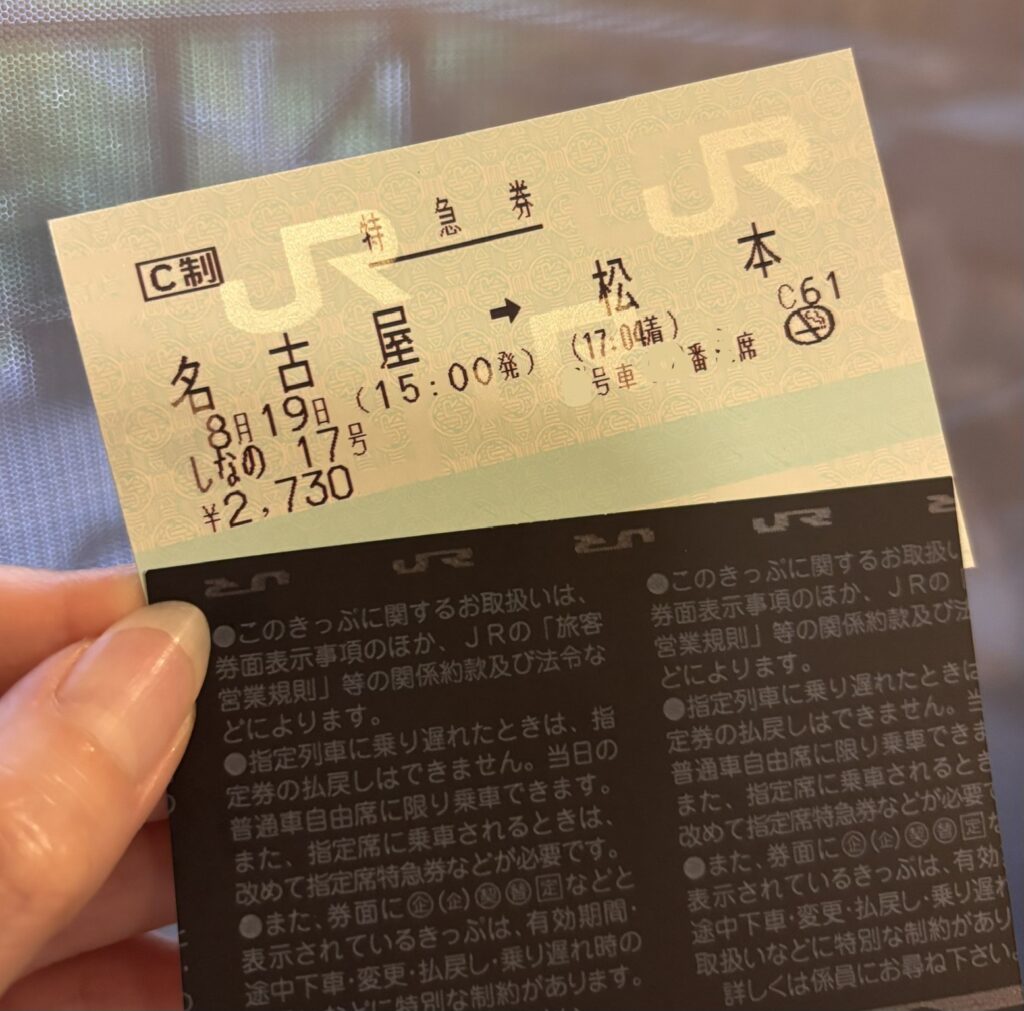
I recently rode the Limited Express Azusa.
So today, I want to share a few things that are useful to know, especially if you are traveling in Japan.
What Is the Limited Express Azusa?
The Azusa is a limited express train that mainly runs between Shinjuku Station in Tokyo and Matsumoto Station in Nagano Prefecture.
Depending on the time of day, some Azusa trains also go to Hakuba Station in Nagano Prefecture, which is farther north from Matsumoto, or to Chiba Station in Chiba Prefecture.
There are also some trains that start from Tokyo Station instead of Shinjuku. And there is another limited express train called the Kaiji, which uses the same type of train and goes as far as places like Kofu Station or Ryuo Station.
So please check carefully depending on the train you want to ride.
To give you a rough idea of the locations, it looks something like this:
[Chiba Prefecture]
Chiba Station
↓
[Tokyo]
Tokyo Station
↓
Shinjuku Station
↓
[Yamanashi Prefecture]
Kofu Station
↓
[Nagano Prefecture]
Matsumoto Station
↓
Hakuba Station
You may still find old information online saying that the Azusa goes from Chiba all the way to Minami-Otari.
But after the March 2025 timetable revision, the Azusa no longer goes to Minami-Otari. It now stops at Hakuba.
So be careful when you are looking at old travel blogs or old timetables.
The Azusa is a train that can be operated in quite flexible ways.
In summer, there may be extra seasonal trains. Some trains may also be connected with the Fuji Excursion at Otsuki Station.
So please check the specific train you want to ride.
And if it feels confusing, feel free to leave a comment!
Tickets Can Be Confusing
Now, this part is very confusing.
The Azusa is a limited express train, so you need a limited express ticket.
You cannot ride it with only an IC card or a regular ticket to your destination.
And this is the part that can get especially confusing.
There are two main types of limited express tickets for the Azusa: reserved seat limited express tickets and seat-unassigned tickets.
There are no non-reserved seat tickets.
There used to be, but not anymore.
A reserved seat limited express ticket is probably easy to understand.
It is like an airplane ticket.
The date, departure time, train name, car number, seat number, and even the seat letter are all decided.
For example:
Azusa No. XX, leaving at XX:XX on Month Day, Car No. X, Seat XXA.
Everything is fixed.
Reserved Seat Tickets and Seat-Unassigned Tickets
A seat-unassigned ticket works differently.
You buy it for the Azusa on a specific day, up to a specific station.
So it is useful when you know which day you want to travel, but you are not sure what time you will take the train.
But here is the scary part.
You do not know whether you can actually sit down until you get on the train.
If the train is full, you may have to stand.
So if you are traveling, I think it is much more relaxing to reserve your seat if you can.
How to Check If a Seat Is Available
By the way, you can check whether a seat is available by looking at the lamp above the seat.
Honestly, even as a Japanese person, I find this a bit confusing.
Red means the seat is available.
Yellow means someone with a reserved seat ticket will get on at the next station.
Green means someone currently has a reserved seat ticket for this section.
That is what the colors mean.
So… what do you think?
Does that make sense to you?
Personally, I always wonder: if the seat is available, shouldn’t it be green? And if it is not available, shouldn’t it be red?
Maybe that is just how it feels from the point of view of someone looking for a seat.
I don’t know. Haha.
I took a photo, so take a look.
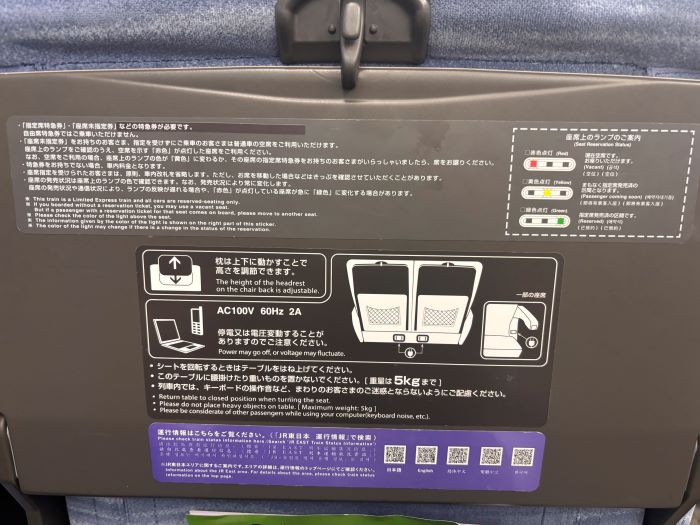
Even if nobody is sitting there, if the lamp says someone will get on at the next station, you have to move.
Moving with your luggage is annoying, and constantly wondering, “Is it okay if I sit here?” is also tiring.
So yes, I recommend getting a reserved seat limited express ticket.
Things to Know About the E353 Train
The details can change depending on which train you ride, so from here, let’s talk about the train itself.
The Azusa is operated using a train called the E353 series.
Here are a few things travelers may want to know about this train.
1. Toilets
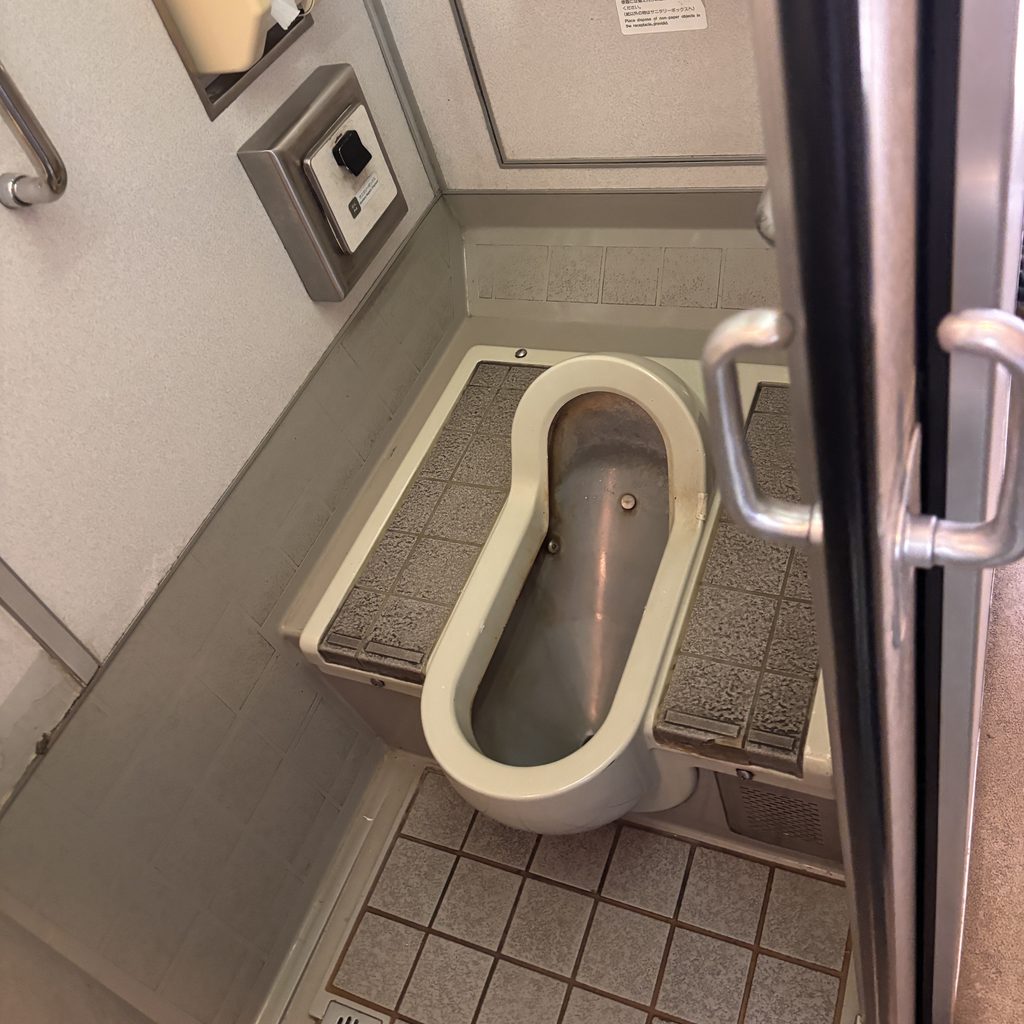
Yes, there are toilets.
Not every car has a toilet, but the train does have them.
One thing to be careful about is that you cannot walk through the Green Car.
Also, if two front cars are connected together — you know, the “head” part of the train — you cannot walk through that section either.
But other than that, you can walk through the train, so I don’t think you need to worry too much about toilets.
They are pretty clean too.
And toilet paper is usually there, as long as it has not run out!
2. Power Outlets
There are power outlets.
They are either in front of your seat or under the armrest.
If you want to charge your phone or use your laptop, you can use them.
They are standard Japanese power outlets.
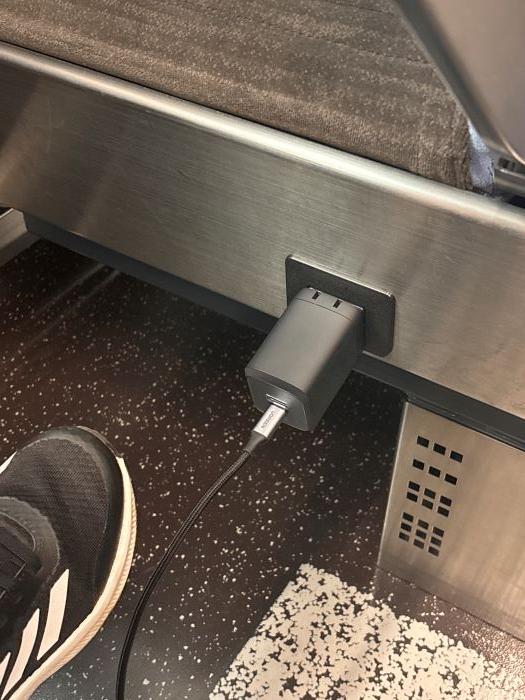
And yes, sorry about the little foot in the photo!
3. Luggage Space
Some cars have luggage space.
But honestly, whether everyone can use it is another question. The luggage space is not that big.
From my point of view, the seat pitch is wide enough that I could put a larger suitcase at my feet without much trouble.
But depending on your body size, that may not work for you.
So please do not assume that there will always be a perfect place for your suitcase.
If you cannot find anywhere to put it, one option is to stay in the deck area with your luggage.
Just don’t leave your luggage there by itself!
Depending on the situation, it may be treated as suspicious luggage, and that sounds like a huge headache.
4. Trash Bins
There are trash bins near the doors.
They are in the deck area, where people get on and off the train.
They are often on one side of the wall near the train doors, so look around there.
5. Food and Drink Service
Food and drink service may or may not be available.
I think it is available on some regular trains, but it may not be available on extra seasonal trains.
So if you would be in trouble without food or drinks, bring something with you before boarding.
The ride from Shinjuku to Matsumoto takes less than three hours, but still.
Sometimes you just want a snack, right?
Enjoy the Ride!
The Azusa uses a newer train, and the ride is comfortable, so I hope you look forward to it.
If the weather is good, you may even be able to see Mount Fuji or the Yatsugatake Mountains from the window.
Have a great trip!